A photo album does one thing well: it freezes a moment. But the full texture of a life — the arguments that preceded the dinner, the inside jokes, the handwriting on a grocery list — rarely survives in photographs alone. As more people think seriously about legacy, memory, and the stories they want to pass forward, a quiet shift is happening. The tools available now make it genuinely possible to preserve not just what happened, but how it felt. What follows are some of the most meaningful and practical approaches to do exactly that.
1. Moving from Images to Narrative with Video and Audio
Still images are the most immediate way to document a life, but they compress experience into a single frame. Video and audio restore what photographs drop: duration, voice, hesitation, laughter, the way someone says a name.
Short documentary-style videos have become accessible without professional equipment. A smartphone mounted on a small tripod, filmed in natural window light, can produce a family interview that holds up for decades. The key is preparation. Open-ended questions — “What was the hardest thing you ever built back from?” rather than “Were you happy?” — generate the kind of answers worth keeping. Plan for sessions of no longer than 20 to 30 minutes to avoid fatigue, and record at least two takes of any answer that feels important.
Audio-only formats are underused and undervalued. A recorded conversation between a grandparent and grandchild, saved as a lossless audio file and backed up to at least two separate storage locations, can outlast almost any physical medium. Services that transcribe audio automatically now cost as little as $0.25 per minute, making it practical to create a searchable written record alongside the original recording.
The comparison worth making here is effort versus outcome. A single 45-minute recorded interview, properly backed up, carries more recoverable story than a shoebox of unlabeled prints. The photographs require context someone has to supply later; the interview is its own context.
2. Object-Based Storytelling and the Physical Record
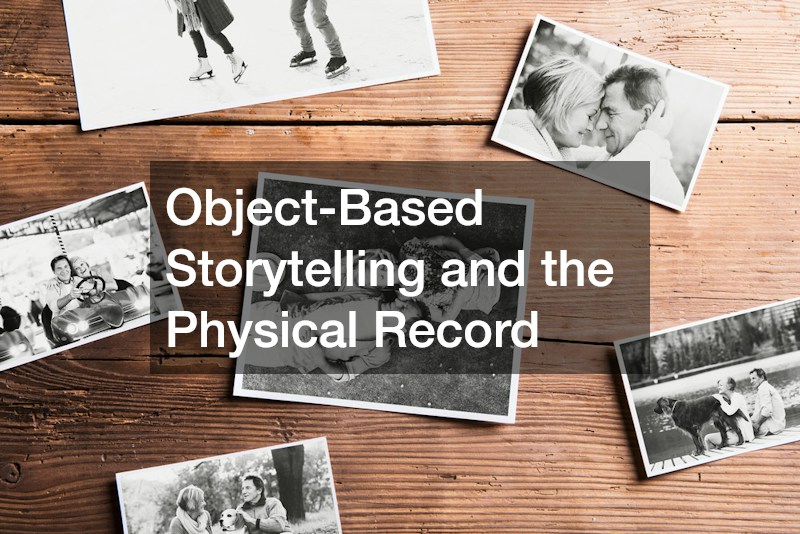
Objects anchor memory in ways that digital files cannot. A worn recipe card, a military medal, a child’s first drawing — these things carry weight, literally and symbolically. The challenge is that objects deteriorate, get lost in moves, or end up in estate sales without anyone understanding what they meant.
One practical solution is to build an object archive alongside a visual record. Photograph each meaningful object against a neutral background with a ruler in frame for scale, then record a short audio note — even 90 seconds — explaining its origin, the person it belonged to, and why it was kept. Store these pairings in a folder structure organized by person and decade, not by the date you created the file.
This approach matters because provenance disappears faster than objects do. Families regularly hold onto items for generations but lose the story attached to them within one or two deaths. A labeled archive built now requires maybe 15 minutes per object and nothing more expensive than a smartphone.
For families with significant quantities of paper — letters, documents, drawings — flatbed scanning at 600 DPI produces files large enough to read handwriting clearly when zoomed. Cloud storage for a year’s worth of this kind of archiving typically costs less than $30 annually through major storage providers.
3. Written and Designed Formats That Go Deeper Than Captions
There is a meaningful difference between a caption and a narrative. Captions label. Narratives interpret, and that interpretive layer is what future readers actually need.
Memoir-style writing does not require a professional writer or a publishable manuscript. A document of 5,000 to 10,000 words, organized by decade or by theme rather than strict chronology, gives context that no photograph can provide. The most durable approach is to write it in a plain text format, saved as a PDF and a .txt file simultaneously, rather than in a proprietary word processing format that may not be readable in 30 years.
For those who find writing difficult, a hybrid approach works well: use a recorded interview as raw material, have it transcribed, then lightly edit the transcript into readable prose. The voice stays intact. The effort drops significantly.
Designed formats — printed photo books with extended captions, zine-style family histories, hand-bound journals — occupy a different position. They are physical objects themselves, which means they are vulnerable to the same deterioration as any other object. But they are also immediately readable without any technology. Printed photo books from archival-quality services typically run $60 to $150 for a standard hardcover edition. For those documenting a specific event rather than an entire life, this is often the most practical and emotionally resonant choice. documentary wedding photographers, for instance, work in a tradition of storytelling through image sequences rather than isolated portraits, and the same narrative logic translates directly to a printed book built around a personal story.
4. Digital Ecosystems and the Long-Term Storage Problem
Most people assume that digital equals permanent. It does not. Digital files are only as permanent as the media they live on, the software needed to read them, and the human effort required to migrate them forward as technology changes.
A well-designed personal archive should follow a 3-2-1 rule: three copies of every file, on two different types of media, with one copy stored off-site or in cloud storage. For a family archive, this might mean an external hard drive at home, a second drive at a relative’s house, and a cloud backup service costing around $10 per month.
Format choice matters more than most people realize. JPEG files compress and lose data with each re-save. For long-term preservation, PNG for images and MP4 with H.264 encoding for video are widely supported and readable across platforms. Documents saved as PDF/A — the archival variant of PDF — are designed specifically for long-term preservation without software dependency.
The deeper problem is organizational. Files that are named “IMG_4892.jpg” and stored in a folder called “Misc 2019” are effectively lost, even if technically accessible. A consistent naming convention — year, subject, brief description, in that order — takes discipline to build but pays back in years of searchability. Scheduling an annual two-hour review session to check storage integrity and update naming is a realistic maintenance habit most families can sustain.
Choosing the Format That Fits the Story You’re Telling
No single format works for every story or every family. The decision depends on three variables: how much material exists, who the intended audience is, and how long the record needs to last.
For a story meant to circulate within one generation — a parent’s 70th birthday retrospective, a couple’s anniversary book — a printed photo book or a short video documentary is usually the right choice. It is tangible, immediate, and requires no technical knowledge from the people receiving it. For a record meant to survive two or more generations, digital preservation with rigorous backup becomes essential, even if it also produces a physical artifact. The physical version will likely outlive one generation; the digital version, properly maintained, can outlive several. Decide first what “done” looks like, then build backward to the tools and formats that support that outcome.